Your Child Is Still in Pull-Ups at Night. Here's What No One Is Telling You.
Sarah Keller · Parent & Researcher
Updated
Wait…before you complete that order
Before you complete that order, whether you call them Goodnites, nighttime pull-ups, diapers or nappies, just trust me and take five.
Not to feel bad. You are doing your best.
But there is something most parents who buy nighttime pull-ups have never been shown. A clinical recommendation or at the very least a simple explanation of what is actually happening in your child's brain every night they wear one.
"Our daughter is becoming too comfortable with nighttime pull-ups. I need to try something different."
"My 5-year-old showed no signs of stopping bedwetting and I'm tired of buying pull-ups!"
— Parent of 5-year-old boy
If that sounds like you, keep reading. This might be the most useful five minutes you spend today.
I was about to do the same thing
I was in the middle of reordering Goodnites XL online when I stopped myself.
My son Ethan had just grown out of the large size. He was seven years old. I sat there on my phone thinking: how much bigger do these get? How long is this going to go on?
I didn't finish the order. Instead I typed a question into Google that I hadn't asked before.
Why is my son still wetting the bed and are pull-ups making it worse?
What I found…made me close the Goodnites tab for good.
Then I came across a study that stopped me dead in my tracks
Scientists in 2020 tracked 755 children. Some wet the bed. Some didn't. They wanted to find out if there was a difference in how long each group had spent in diapers or nighttime pull-ups.
There was.
26 mo
Average time bedwetters stayed in disposable diapers
20 mo
Average for children who did not wet the bed
That six-month gap matters. And it gets sharper.
You might think the pull-ups didn't cause the bedwetting. That kids who wet the bed just happened to wear them longer.
But the UK's National Health Service tells doctors to remove pull-ups as a first treatment step. Before medication. Before a specialist.
Think about that. They don't tell doctors to remove something unless removing it helps.
+17%
Increased bedwetting risk for every extra month a child spent in disposable diapers
Scientific Reports, Nature — 2020
89%
Lower chance of bedwetting for children who got out of disposables early compared to those who stayed in them the longest
Scientific Reports, Nature — 2020
Clinical Guideline
This is why the UK's National Health Service now includes "trial without nappies or pull-ups" as a first-step recommendation, before medication, before specialist referral because the evidence showed that simply removing the pull-up improved outcomes on its own.
Here is why this happens.
When your child wets a nighttime pull-up or diaper, they don't feel it. The material absorbs instantly. The brain never gets the signal it needs. The "gotta go" signal is lost.
So the brain never learns to send one.
1 in 7
Children per year whose bedwetting resolves on its own
Forsythe & Redmond, Archives of Disease in Childhood
Which means if your child is seven and wetting the bed tonight, the odds say they will still be doing it at eight. At nine. Maybe even all the way through their pre-teens.
Not because there's something wrong with them.
But because every night in a pull-up is a night the brain doesn't learn.
I found the reason bedwetting keeps happening night after night…
Researchers found that children who wet the bed are measurably harder to wake up than children who don't.
Their brains need a significantly stronger signal just to jolt them awake. Scientists call this a higher "arousal threshold."
Key Insight
It is not stubbornness. It is not laziness. It is a brain connection that hasn't finished forming yet. The good news: it can be trained. But only if the brain actually receives the signal, which is…the feeling of wetness, at the moment it happens.
And there's a window.
Doctors recommend starting no later than age 6 or 7, when the brain is most able to build this connection quickly. The window doesn't close completely, but it narrows every year.
Every nighttime pull-up keeps that window shut.
So what happens if you just remove the pull-up and wait it out?
Most bedwetting children sleep so deeply that they don't wake up, even when lying in a soaked bed.
The accident happens. The sheets are wet. They don't move an inch.
Because the brain is still receiving no signal.
Removing the pull-up exposes the child to wetness. But the timing is wrong.
The instant the bladder reaches capacity, it overflows. By the time the wetness registers, it's already too late.
Waiting it out works for some children. About 1 in 7 resolve naturally each year.
For the rest, months pass. Years pass. Wet sheets every morning, and a brain that still never learned the signal.
What the brain actually needs is a sharp, immediate wake-up call at the exact moment the bladder is full, not after.
AT. THE. MOMENT.
Researchers figured out how to deliver that in 1938.
But nobody told parents that a permanent fix existed since 1938
Researchers figured out how to train the brain-bladder connection in 1938.
Two psychologists, Mowrer and Mowrer, developed a method: pair the very first drop of moisture with an immediate wake-up signal. Do it consistently, night after night.
Over a few weeks, the brain builds the shortcut.
Full bladder → wake up
The brain connection that stops bedwetting permanently
65–75%
Success rate and the lowest relapse rate of any bedwetting treatment available
Bedwetting Alarm Research History
Most parents have never heard of it because the original devices were terrible.
Wires, bed mats, alarms loud enough to wake the street. And they fired too late. By the time the sensor detected anything, the accident was already done.
So doctors stopped recommending them. Pull-ups filled the gap.
The method was always right. It just needed a better device.
And I found it randomly while doomscrolling at 11 pm on a Thursday
I found it in a mom group. Someone had posted about her son who was still in Goodnites at age ten, a heavy sleeper and nothing had worked for him.
The replies were full of the usual suggestions. Then one mom mentioned something different: NightGuard.
I looked it up that night.
How NightGuard works
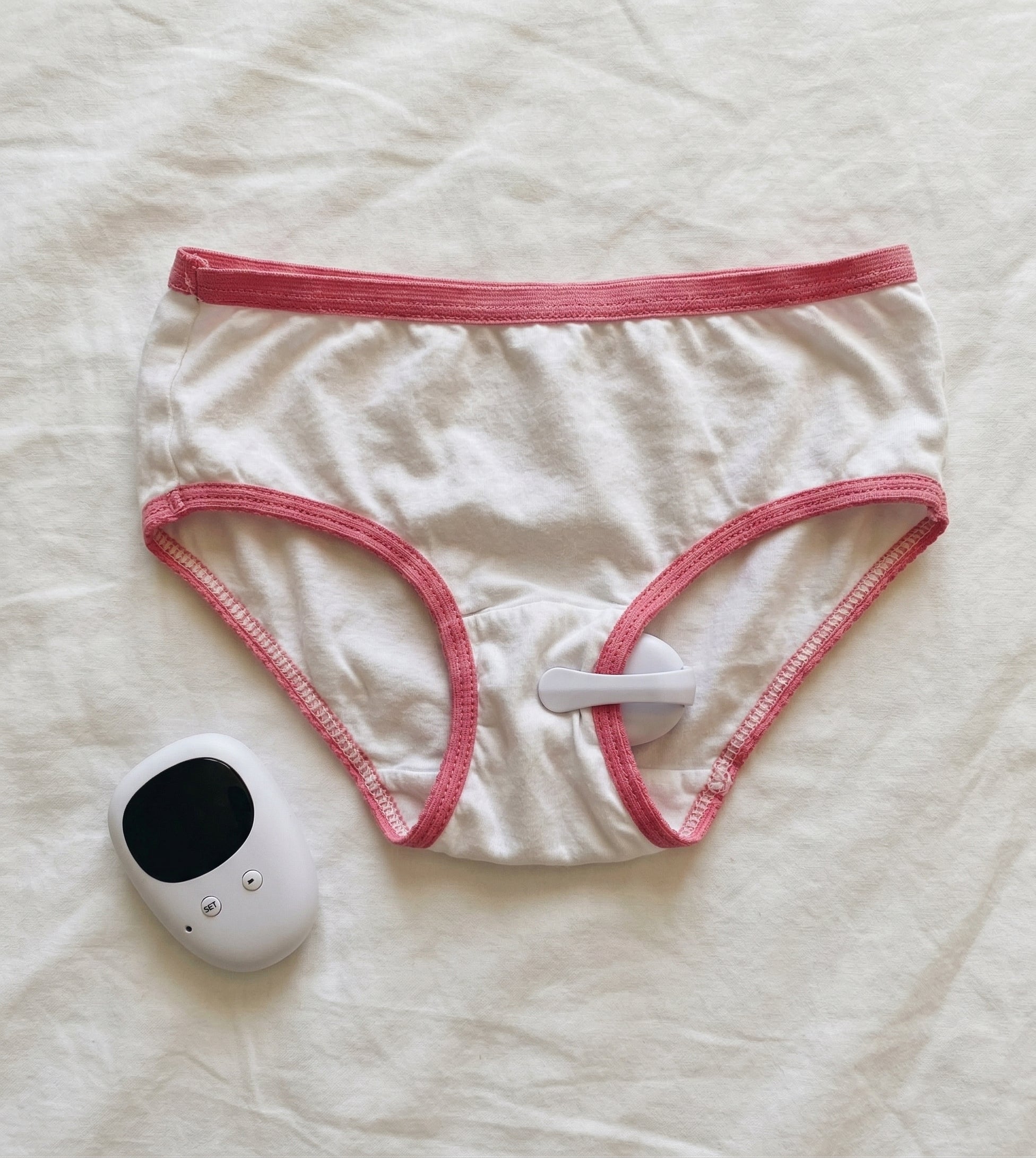
Small sensor clips to underwear. It detects the very first drops of moisture, before a full accident.
Wireless alarm fires sound + vibration simultaneously. They call it NeuroWake™ technology. Sound alone cannot reliably wake a deep sleeper. Vibration on the body gets through when nothing else does.
Over 4–8 weeks, the brain builds a pattern. The child starts waking before the alarm fires. Then they sleep dry without waking at all. The connection is formed.
The way it works really excited me because it finally felt like I could end my kid's bedwetting for good so…
I ordered it that same night.
But what happened over the next 6 weeks brought tears to my eyes
Nights 1–3
The first three nights were hard. Ethan woke up annoyed. I almost sent it back.
Night 9
He got up on his own before the alarm fully fired. I heard the bathroom door close and stood in the hallway and cried.
Week 3
Five dry nights in a row.
Week 6
His first sleepover since the third grade. He packed his bag himself. No Goodnites. No pull-ups. Nothing.
He looked at me at the door and said: "I don't need those anymore."
— Ethan, packed and ready for his first sleepover
I almost cried because I realized I just got my boy back.
The longer you wait, the harder this gets
Ethan was 7 when we started. I am glad we didn't wait any longer.
The brain is most ready to build the bladder connection between ages 5 and 10. After that it takes longer. It still works but it's a harder climb every year.
And the cost isn't just biological.
"My kid was really embarrassed when a friend found pull-ups at our house. He was angry at his sister for sharing his biggest secret."
— Parent of 8-year-old boy
"He can't have sleepovers with friends. He's in travel sports and has to take a rolled-up sleeping bag with a wet pad and wear adult pull-ups."
— Parent of 14-year-old boy
You can wait to let them grow out of it or save the sheets with a pull-up but you cannot assess the silent damage it does to their self-esteem and confidence.
Don't let yourself be the parent who doesn't see through their kids' struggle.
Be better, starting today.
Choose right or choose regret
You were about to order more Goodnite pull-ups. You can still do that. They will keep the sheets dry. But they will not teach your kid to get rid of the habit.
Ethan is 9 now. Dry for over a year. He texted me from his first sleepover. I keep it on my phone. It reminds me of the night I almost reordered the pull-ups and didn't.
Yes, this is specifically what it was designed for. The NeuroWake™ technology uses both sound and vibration simultaneously, delivered directly on the child's arm. Clinical research confirms that children who wet the bed are measurably harder to rouse than other children. Two-signal arousal overcomes this in most cases.
Most families see the first changes in weeks 2–3: the alarm starts firing less, or later in the night. First dry nights typically appear around weeks 4–6. Consistent dryness follows at weeks 8–12 for most children. Some take longer, the 60-night trial covers this.
No. The training window narrows after age 10, but it does not close. Alarm conditioning still works for older children and teens—it typically takes a few weeks longer. The same method applies.
Bed mat alarms fire after urine has soaked through clothing and reached the mat. The accident is already complete. NightGuard detects the first drop, at the point of the underwear, before a full void. That timing difference is everything for conditioning the brain.
Yes. NightGuard contains no medication, no drugs, and no invasive elements. The sensor is a small clip. The alarm is worn on the child's arm, with an optional armband holder available separately for a secure fit. It is recommended for children ages 4 and up.
References
Scientific Reports, Nature (2020) — Diaper overuse & primary enuresis. 755 children. 17% risk per extra month. 89% lower odds for early exit. nature.com/articles/s41598-020-70195-8
NICE Clinical Guideline CG111 — NHS first-line recommendation: trial without pull-ups before medication. nice.org.uk/guidance/cg111/chapter/1-guidance
Forsythe & Redmond, Archives of Disease in Childhood — 1,129 children. ~15% spontaneous resolution per year. pubmed.ncbi.nlm.nih.gov/4830115
PMC — Sleep & Sleepiness in Children with Nocturnal Enuresis — Higher arousal threshold in bedwetting children. pmc.ncbi.nlm.nih.gov/articles/PMC3022939
PMC — Alarm Therapy in Treatment of Enuresis (2021) — 65–75% success rate. Age 6–7 recommendation. pmc.ncbi.nlm.nih.gov/articles/PMC8453315
Wikipedia — Bedwetting Alarm — Mowrer & Mowrer, 1938. Historical evidence base for conditioning therapy. en.wikipedia.org/wiki/Bedwetting_alarm